 |
 |
 |
Prionitis lanceolata
Lance-leaf Bleachweed
30 October 2025
Big Beach, Ucluelet, B.C., Canada.
Tide: 6.2 feet (measured at Ucluelet Tidal Station) at 2:15pm PDT (time of interaction in-situ).
Weather: Mix of sun & cloud, wind WSW 10 km/hour, sea rippled, low SW swell, humidity 70%, 11 ˚C.
Moon: Waxing Gibbous, (61.4%, 9 days); Next Phase, Full Moon, 5 Nov 2025 at 5:19am PDT: Previous Phase, First Quarter, 29 Oct 2025 at 9:20am PDT.
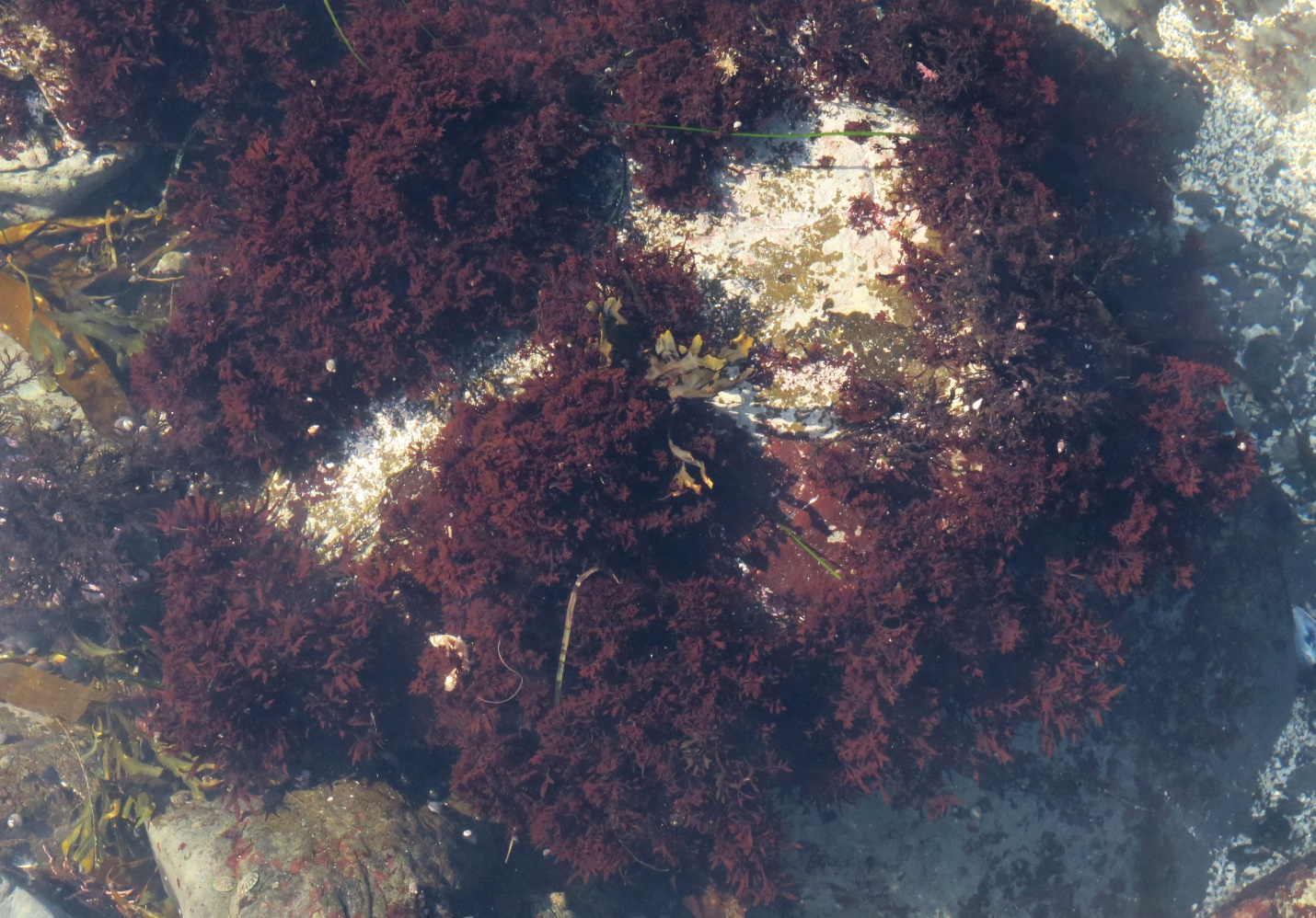
Figure 1: Viewed through shallow water, this grouping of Prionitis lanceolata is looking quite healthy and vital at this late season date. Crushed shells make a strong contrast to the deep red color and a few other macro algae are growing here as well including Fucus distichus, Hildenbrandia rubra and Neorhodomela oregona. Bits of debris are easily caught in the branches of Prionitis lanceolata including sea grass blades, pieces of articulated coralline algae and at other places large chunks of detached kelp blades. Big Beach, Ucluelet, B.C., Canada. October 30, 2025. Photo ID 27858 ©Seaweedwhisperings.com
Person 1:
Locally abundant but not dominating the landscape.
Poking, jabbing, teasing, taunting.
I can’t tell whether or not it’s serious about the taunts. Perhaps that’s just a cover for being insecure.
Its appearance is highly variable, adding an air of confusion when I interact with it, period. Is it “this” or is it “that”?
Its form is so variable it’s impossible to tell the “real” Prionitis lanceolata.
I get the sense that its expressions are not malicious or malevolent, but more designed to hide the depth of its being.
At times we’ve seen it obviously draped over and around other seaweeds, but during our current interaction it was exhibiting more of a shy nature, peeking out as a skirt from beneath and at the fringe of several Neorhodomela oregona clumps.
I don’t think it changes its presentation quickly as does an octopus, but will put on different costumes to fit its mood and intentions.
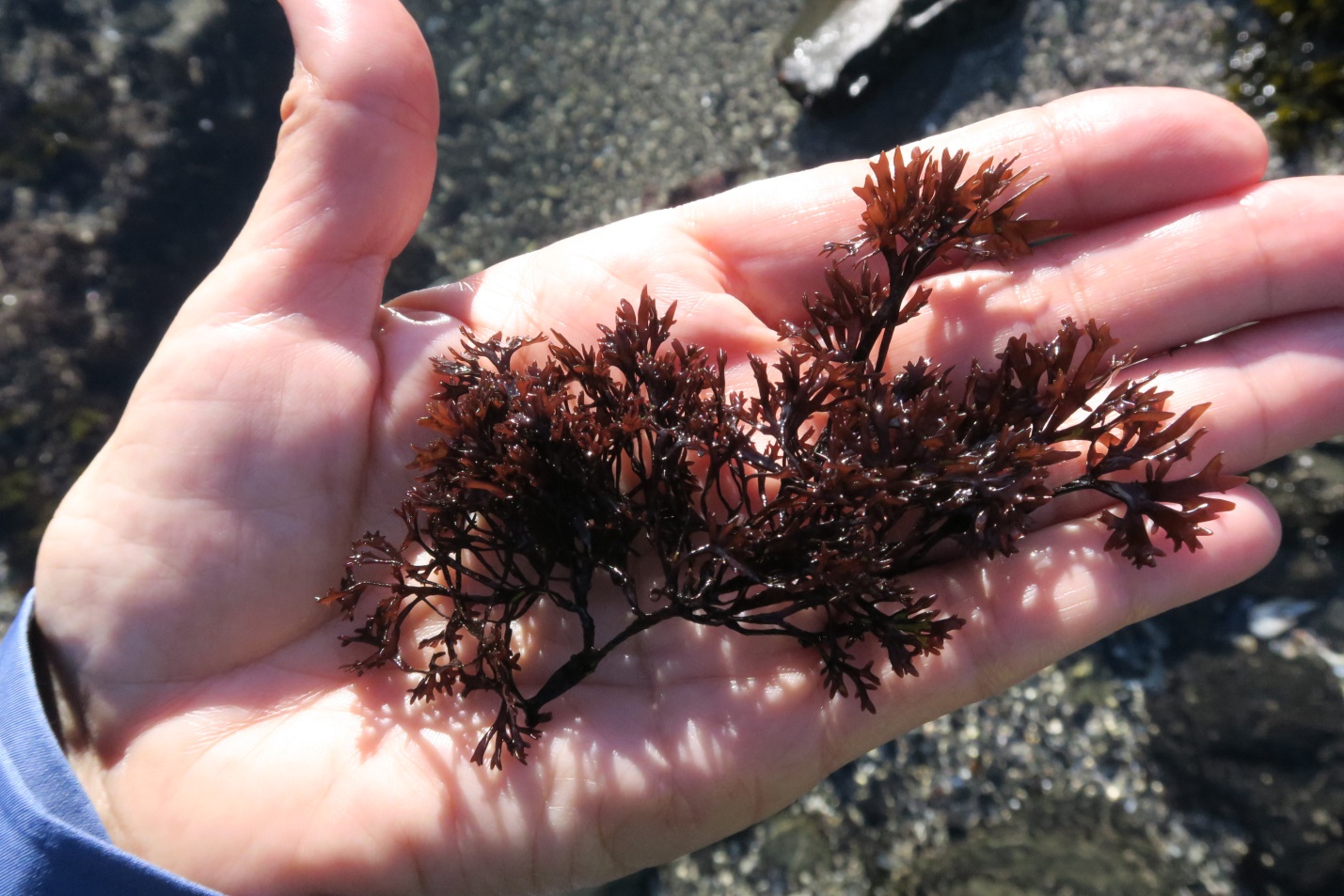
Figure 2: Viewed in hand, a more detailed look is possible. The features of this particular location and the late fall season were factors contributing to this particular form; the species is noted for having a highly variable morphology. Big Beach, Ucluelet, B.C., Canada. October 30, 2025. Photo ID 27859 ©Seaweedwhisperings.com
Person 2:
Who are you?
Deep red bushy alga growing on rocks and currently submerged at this moderate tide?
You are in a channel that is water filled & that also collects a coarse mix of sand and broken shell.
It seems to me that I should know you..., but I can’t quite place you…
I’m certain you are not a rare species, however your distinguishing traits are not clearly displayed. Partly your bushy growth makes seeing your full form complicated and so visual clues are obstructed.
It is true that we haven’t often been able to explore these beaches of the mid-intertidal level in late October – a time when some perennial seaweeds are still affixed and growing in situ. This is in contrast to the profusion of cast ashore algae that the season’s storms and high tides routinely present.
I pulled a branch or two away from a robust “shrub” of this seaweed as I was very interested to be able to study it more fully to hopefully identify it. And identify it we finally did, the next day..., after much searching through various resources and references.
This all makes me think that a strong
trait
to you is that of going ‘incognito’. Of being out in plain view,
even proudly so, but also being somewhat in disguise.
Not
distinctly this, not distinctly that. Yet admirable just the same.
Your main axes are unglamorous but sturdy. All the interest is in your branches and proliferations. Here you make interesting shapes, and knowing you from other locations and seasons, your shape can and will vary to suit the circumstances you’re dealing with.
Many different presentations – so much so that you can seem like several different species.
You do not seem to be interested in being consistently the same, or have you let go of any one form as being ideal for you?
Do you combine the need to be out in the world with a desire to remain unidentifiable?
Why?
Have you made some irreparable blunder and you therefore are avoiding the comments and reactions of others? Or have you moved past caring about what others think because you are simply occupied with surviving what is currently going on for you?
You tend to catch bits of marine debris in your branches; perhaps this provides distraction and shifts attention away from you? Also if I step back and look at you as a grouping, the sense I have is that your look obstructs any real understanding and that you project a kind of contrariness that would keep most others at some distance.
You don’t seem to have picked the easiest places to grow, or maybe the most desirable locations were not available to you. You certainly face exposure to the elements up here in the mid-intertidal zone. When you grow at lower tide levels you are rather out-competed, it seems. Living where you do I think you must be fairly tough, or perhaps it is more than you are resigned and accepting of it – as if the fight to do better is gone out of you.
I feel that you have a certain willingness to accept a degree of punishment or to “face the consequences” of some prior action; like wearing a ‘hair shirt’, I wonder what wrongs you are atoning for.
Even your red coloration, while it is attractive and certainly it is red, it is also dark. Do you carry a shadow within you, Prionitis lanceolata?
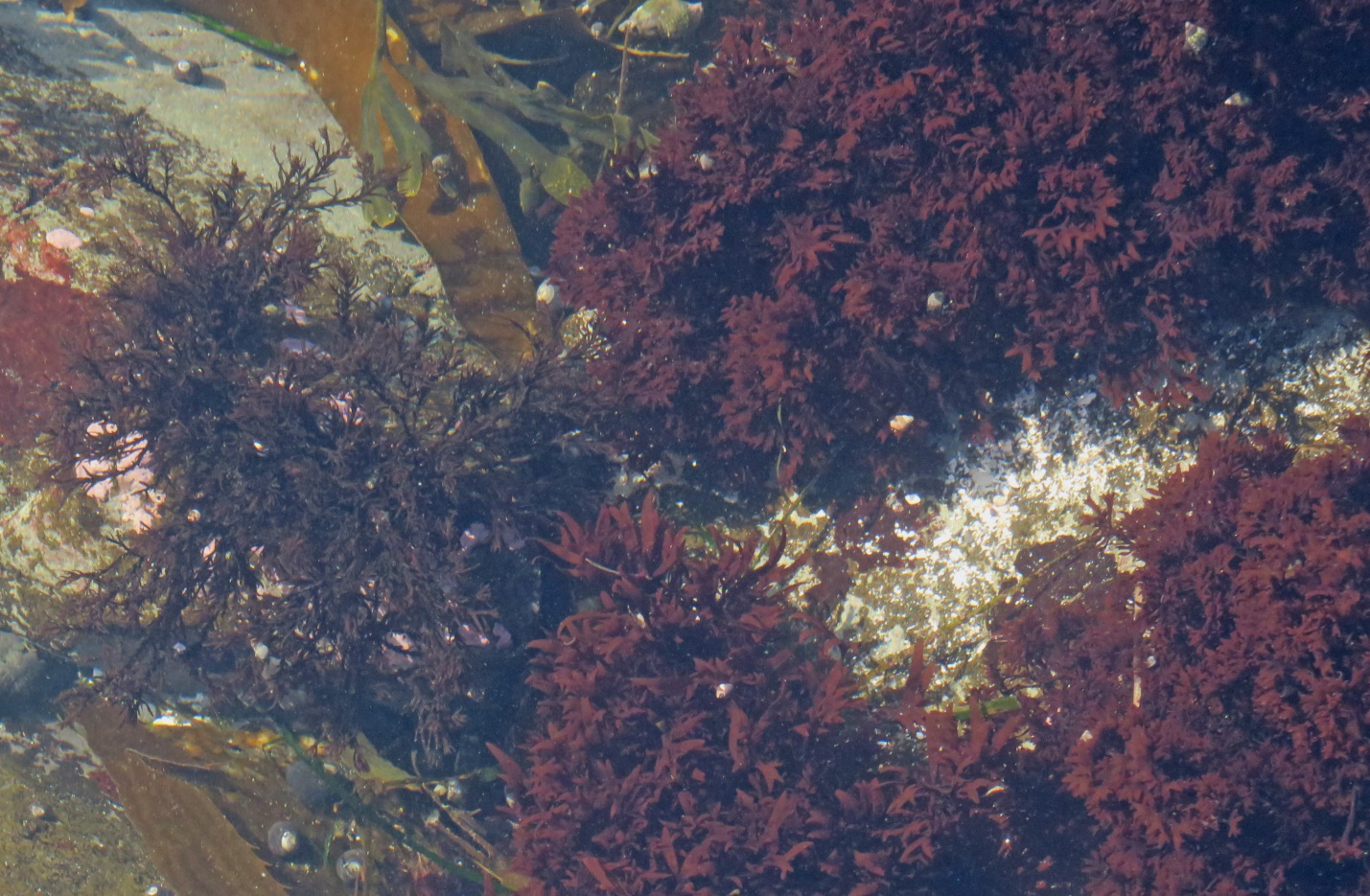
Figure 3: Underwater view – the bushy looking brownish red alga is Prionitis lanceolata and the darker black-brown is Neorhodomela oregona. A few pieces of Fucus distichus and Macrocystis tenuifolia and other kelp blades provide color contrast and size comparisons. Big Beach, Ucluelet, B.C., Canada. October 30, 2025. Photo ID 27860 ©Seaweedwhisperings.com
Discussion:
The species name (lanceolata) of this seaweed evokes certain ideas. Many times when we’ve observed it in the past, its side branches really do look rather like lances or blades or the serrations of some cutting instrument. However, Prionitis lanceolata is not a proactive soldier bearing arms as it faces conflict; the situation we could perceive is one of defence and desperately trying to survive. It is like they have been “caught on the back foot” and may have even gone past the point of defending themselves and are confronted with the idea of surrender.
As just mentioned the “lances” could be seen as blades or weapons, and the feeling of needing to face life while being always so heavily armed is one where it seems that the entire world could suddenly be truly against you; all could be lost and friends and allies are very few in number or they have other priorities. There is significant loss that has brought them to these circumstances. It is lonely path to navigate and there can be regret or deep shame that creates the shadow they sometimes carry within. Pride is now one more thing to lt go of, if they can.
They’ve got multiple layers of protection. The armaments; the costumes or disguises; the ability to not be recognized when out in plain sight or when hidden and covered; the ability to survive in various habitats and to endure difficult circumstances. This seaweed can also grow with quite widely differing morphologies depending upon the location it finds itself living in. So it has the trait of being able to give up old preferences and take on what is needed in the current time and place. This is truly a talent, but alternatively they can feel a compulsion to react with opposition to what it is that they see they must do, and in this state they can be rather stubborn and unreasonable – stubborn to the point of prolonging harm to themselves. Eventually they find that in ceasing to resist, they can find peaceful acceptance – they can drop their weapons and defences. Letting go opens the way to the humility and true understanding that was unavailable to them before.
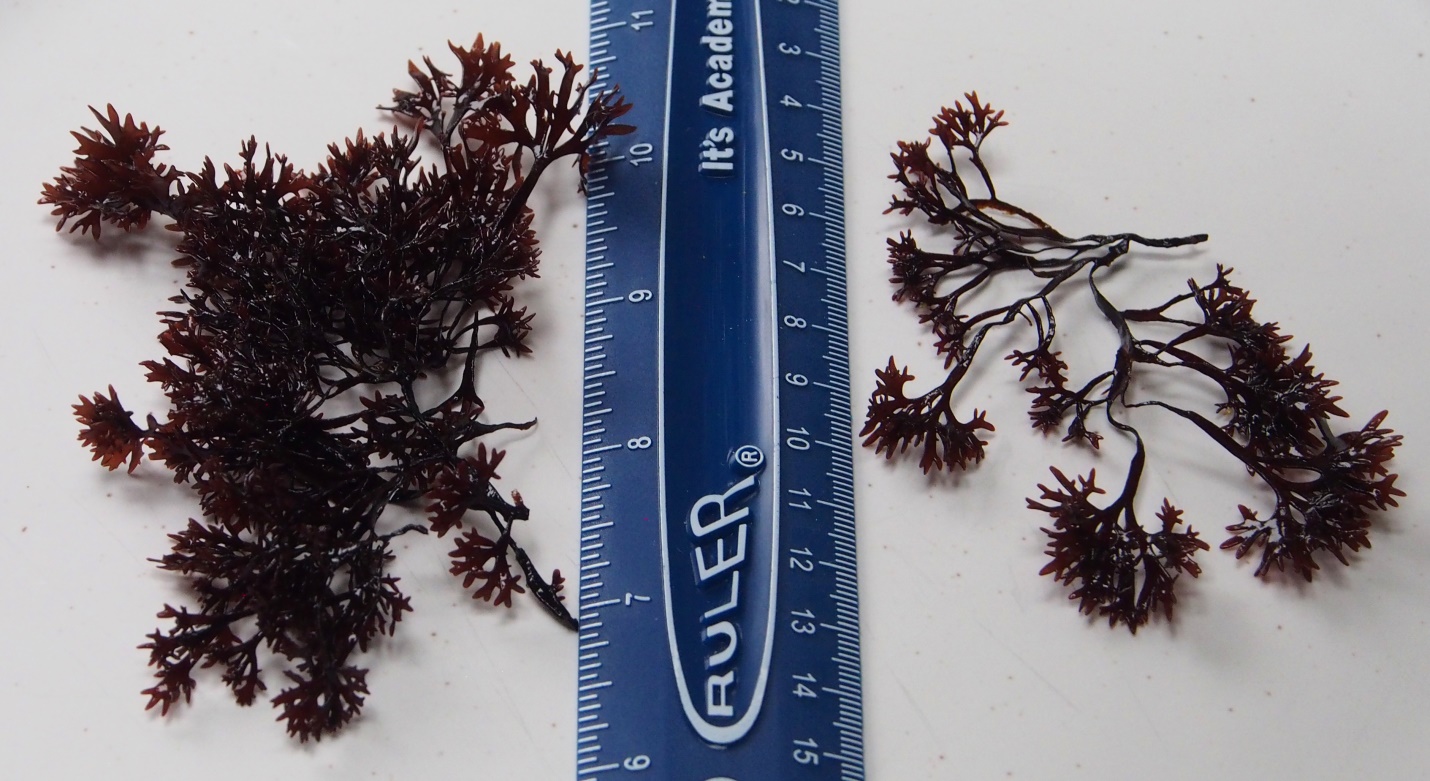
Figure 4: Shown next to a ruler, size and form of Prionits lanceolata can be more accurately grasped. In its habitat, this seaweed looks quite bushy and its structure, including the flattened central axes of the blades, is difficult to ascertain. Big Beach, Ucluelet, B.C., Canada. October 31, 2025. Photo ID 27861 ©Seaweedwhisperings.com
Biology & Natural History Information:
Description:
In publications describing this species, there is an interesting qualification. The Marine Algae of California says: “The populations of this common and highly variable species might be best described separately.” In fact it seems “almost impossible” to pick a “typical” specimen for description. The various descriptions published are separated by habitat details and include: Mid- and low-intertidal thalli; Subtidal thalli; Populations of high intertidal and of high, deep, permanent tidepools subject to extensive insolation (exposure to the sun’s rays); Thalli growing in altered environment of intertidal sewage outfall. So, with that clearly stated we will give a very loose description of this red alga. Features to note typically include width of central axes of the thalli, branching pattern, and arrangement and length of proliferations. Stipes are several to numerous arising from a discoid holdfast. Branching is frequent and irregularly dichotomously divided. Proliferations along the branches are pinnately arranged. Plants have are reddish to light red and brown, sometimes purplish to brownish black in color. Within their range, northern specimens tend to be shorter with slender branches and proportionately long proliferations; specimens from southern California tend to be longer and have proliferations more irregular in occurrence.
Habitat:
Locally abundant, perennial red alga, grows affixed to rock of wave swept coastlines. It is tolerant of a very wide range of habitats and can be found from the high intertidal, in perennial tide pools, all the way down to the subtidal at 30 meters depth.
North Pacific Distribution:
Vancouver Island, British Columbia to Punta Sana Rosalia, Baja California.
Remarks:
Type specimen locality is Monterey, California.
Classification:
Empire: Eukaryota
Kingdom: Plantae
Subkingdom: Biliphyta
Infrakingdom: Rhodaria
Phylum: Rhodophyta
Subphylum: Eurhodophytina
Class: Florideophyceae
Subclass: Rhodymeniophycidae
Order: Halymeniales
Family: Halymeniaceae
Genus: Prionitis
Species: Prionitis lanceolata (Harvey) Harvey 1853
Former name(s): Homotypic synonyms: Gelidium lanceolatum Harvey 1833; Zanardinula lanceolata (Harvey) G.De Toni 1936. None; there are no synonyms listed for this species in AlgaeBase. Heterotypic synonyms: Prionitis ligulata J. Agardh 1851; Grateloupia americana S.Kawaguichi & H.W. Wang 2001.
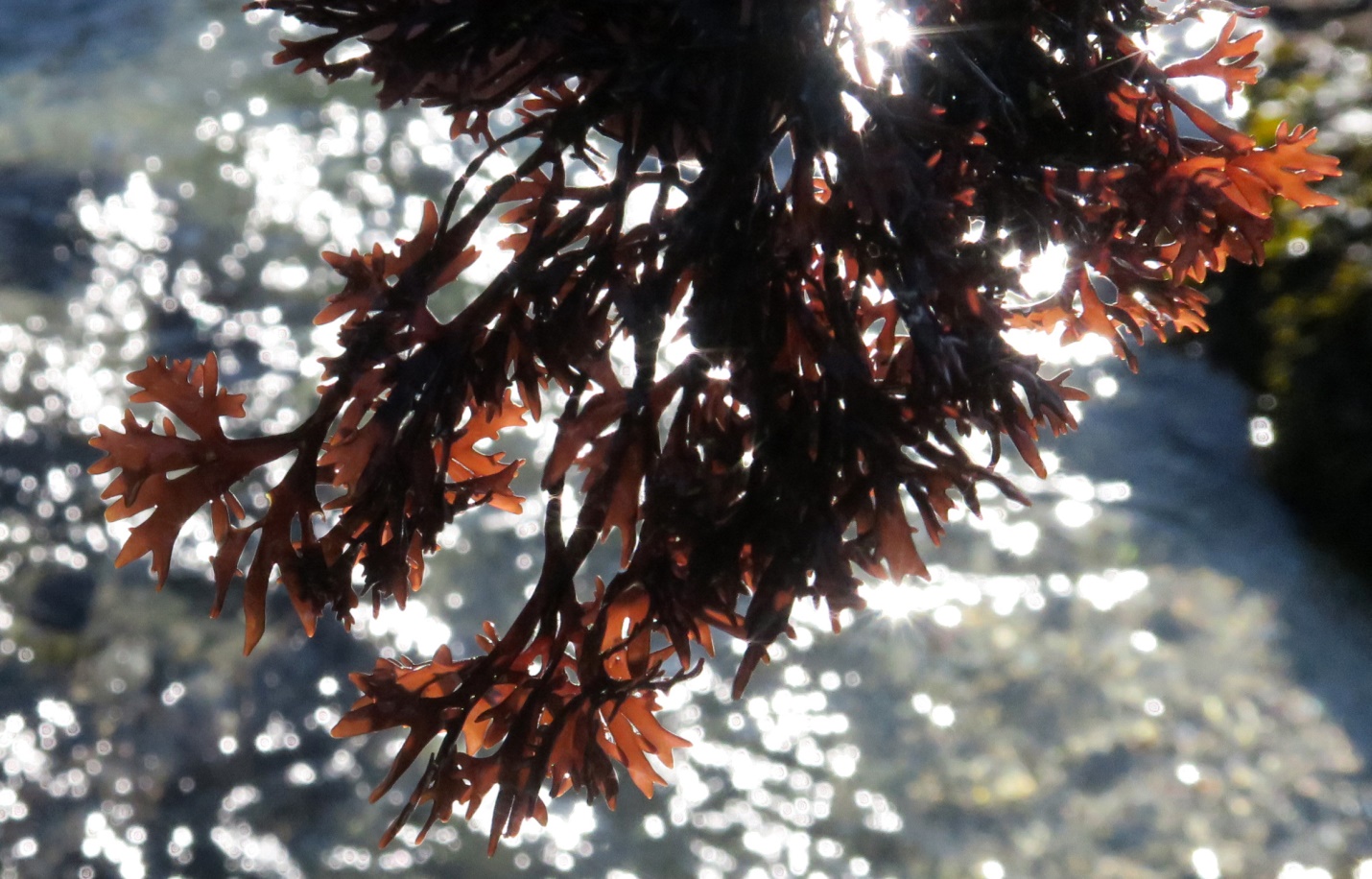
Figure 5: The morphology of these blades had us confused – this seaweed seemed as if it was familiar and that we really should recognize it, yet it was presenting in a way that we couldn’t quite place. Held up and backlit the true red-ness shows very clearly. Big Beach, Ucluelet, B.C., Canada. October 30, 2025. Photo ID 27862 ©Seaweedwhisperings.com
